
Moles and Percents
Why do we need Moles?
A chemical mole, or mol, is a unit of measure, just
like a gram or an ounce. It is used internationally so that all chemists speak the
same measurement language. The mole was invented because, well, it made sense. Scientists
were having a hard time converting between atoms of an element and grams of an element
(grams were the previous standard of measure), so scientists came up with a “mole”
of substance, which is defined as anything that has 6.02×10²³ particles
in it.
This is based off of a mole of carbon, which has 6.02×10²³ carbon atoms
in it. Carbon is often used to define chemical principles and constants, because
it is one of the oldest and most easily observed elements, and it occurs naturally.
You might recognize 6.02×10²³ as Avogadro’s number; this number is used
as a constant throughout chemistry, and here we’re going to use it to define the
mole. Usually, moles refer to particles that make up a certain amount of an element,
and we use moles to measure how much of a substance is reacting in a chemical equation.
However, you can also measure other things in moles—for example, a mole of hippos
would be 6.02×10²³ hippos . . . which is actually quite a lot. When you
think about a mole as 602,000,000,000,000,000,000,000 hippos, it seems like way
too big of a number to be describing something that fits in a beaker in the chem
lab! However, because atoms are so small (remember, we can’t even see an atom with
just the human eye) there are bunches of atoms in everything we’re measuring. Therefore,
a mole is actually a very appropriate way to measure chemical substances.
Another benefit of using moles to measure substances is that it directly correlates
to the number of atoms and molecules and grams. A mole tells you what fractional
part of Avogadro’s number you’re working with; for example, if you have .25 mol,
you would have .25 (or 25%) of Avogadro’s number, which is 1.505×10²³
(.25 * 6.02×1023=1.505×10²³).
Avogadro’s Number
Every chemist has dreamed that atoms were large enough to see and manipulate one at a time. The same chemist realizes after considering it, that if individual molecules were available for manipulation, it would take far too long to get anything done. The view from the atom is very different from the view of trillions and trillions of atoms. The mass action of the atoms that we see on our “macro” view of the world is the result of the action of an incredibly large number of atoms averaged in their actions. The most usual way we count the atoms is by weighing them. The mass of material as weighed on a balance and the atomic weight of the material being weighed is the way we have of knowing how many atoms or molecules we are working with. Instead of counting eggs, we can count cartons of eggs, each carton of which has a given number, a dozen. Instead of counting B-B’s, we can count liters of B-B’s and find out how many B-B’s are in a liter. Instead of counting rice grains, we buy kilograms or pounds of rice and have an idea of how many rice grains are in the container.
There are less than one hundred naturally occurring elements. Each element has a characteristic atomic weight. Most Periodic Charts include the atomic weight of an element in the box with the element. The atomic weight is usually not an integer because it is close to being the number of protons plus the average number of neutrons of an element. Let’s use the atomic weight as a number of grams. This will give us the same number of any atom we choose. If we weigh out 1.008 grams of hydrogen and 35.45 grams of chlorine and 24.3 grams of magnesium, we will have the same number of atoms of each one of these elements. The neat trick with this system is that we can weigh the atoms on a grand scale of number of atoms and get a count of them.
This number of atoms that is the atomic weight expressed in grams is Avogadro’s number, 6.022 E 23.
The name for Avogadro’s number of ANYTHING is a mole. A mol of aluminum is 27.0 grams of aluminum atoms. Aluminum is a metal element, so the particles of aluminum are atoms. There are Avogadro’s number of aluminum atoms in 27.0 grams of it. But 1.008 grams of hydrogen is NOT a mol of hydrogen! Why not? Remember that hydrogen is one of the diatomic gases. There is really no such thing as loose hydrogen atoms. The total mass of a single hydrogen diatomic molecule (H2) is 2. 016 AMU. A mol of hydrogen gas has a mass of 2.016 grams. In that 2.016 gram mass is Avogadro’s number of H2 molecules because that is the way hydrogen comes. A mol of water is 18.016 grams because each water molecule has two hydrogen atoms and one oxygen atom. A mol of water has in it Avogadro’s number of water molecules. Another way to view the same thing is that a formula weight is the total mass of a formula in AMU expressed with units of grams per mol.
So Avogadro’s number is just a number, like dozen or score or gross or million or billion, but it is a very large number. You could consider a mol of sand grains or a mol of stars. We are more likely to speak of a mol of some chemical, for which we can find the mass of a mol of the material by adding the atomic weights of all the atoms in a formula of the chemical. The unit of atomic weight or formula weight is grams/mol.
The chemical formula of a material should tell you; (a) which elements are in the material, (b) how many atoms of each element are in the formula, (c) the total formula weight, and (d) how the elements are attached to each other. The symbols of the elements tell you which elements are in the material. The numbers to the right of each symbol tells how many atoms of that element are in the formula. The type of atoms and their arrangement in the formula will tell how the elements are attached to each other. A metal and a nonmetal or negative polyatomic ion shows an ionic compound. A pair of non-metals are bonded by covalent bonds. Some crystals have water of hydration loosely attached in the crystal. This is indicated by the dot such as in blue vitriol, Cu(SO4) · 5H2O, showing five molecules of water of hydration to one formula of cupric sulfate.
The unit of the formula weight or molecular weight or atomic weight is “grams per mol,” so it provides a relationship between mass in grams and mols of material: nFw = m
Now we’ll show you how to do common conversions from grams to moles to atoms, and
back again.
Gram to Mole Conversion
Convert 15.5 grams C to mol.
First, locate your periodic table. Then, locate C (carbon) on the periodic table.
It is in row 2, column IVA. Be sure to locate the atomic weight of this element,
which will most likely be listed under the symbol for the element, but could also
be near the upper right hand corner of the element’s box on the periodic table.
Please note that the atomic weight is also referred to as relative atomic mass.
For carbon, it should read 12.01, or 12.011 depending on how many significant figures
your periodic tables uses. We are going to use 12.01 in this calculation.
Now that we’ve found all of our information, we’re going to set up dimensional analysis.
You’ll start with a table, like this:
And then you can begin filling in the information. You’ll always start in the upper
left hand corner with the information given to you in the problem. In this case,
we were given 15.5 g C to convert, so we’re going to put in 15.5 g C in the upper
left hand corner. Notice that we can abbreviate grams as g, but also note that we
always include the symbol for the element we’re working with. Although it may not
seem important now, it will be in future conversions. Here’s what the first step
would look like:
Now, we have to fill in the conversion part, which is the two boxes on the right
hand side. We want the items with the same units (grams, moles, etc) to be diagonal
to each other, because we want similar units to cancel. In other words, if g C are
across from each other, we can cross out g C and use the units we’re converting
to. Technically, we are performing division, which is what cancels the units. We’re
going to use 12.01 g/mol as our conversion factor. Any of the atomic weights you
get from the periodic table will have the units of g/mol, which stands for grams/mole.
Now, one thing that we should explain before we get started is that by giving 12.01
g/mol that unit label, we are technically saying that there are 12.01 grams for
every 1 mole. This is important to remember as we fill out our dimensional analysis
box. Now, remembering that we are going to place amounts with the same units diagonally
from each other, we’re going to put 12.01 g C in the bottom right hand corner of
our dimensional analysis, like this:
Now, we have to put in the “1 mol.” We’re going to put it above the 12.01 g C, because
we know that those two are equal. 12.01 g C = 1 mol C. That’s why we can write them
as a grams per mole fraction, because they express the same value. Here’s what our
dimensional analysis looks like now:
Now, notice that the units we don’t want, grams, are across from each other. We’re
going to circle them in red so that you can see them. We have the units we do want,
mol, in the upper right hand corner. No matter how many columns of conversion factors
you may have, the units you want to end up with should always be furthest to the
right, in the last column. The units you want can be on the top or the bottom, but
they should never cancel with other units. Notice that in this problem, we have
grams canceling (because that’s not what we want) whereas moles do not cancel, because
we want our answer in moles. We’re going to circle moles in green, so that you can
see it more easily.
At last, we’re ready to do our calculation. In our dimensional analysis box, we
are going to multiply by any numbers on the “top” row, and divide by any numbers
on the “bottom” row. It would look like this:
Now, the calculation would go as follows:
15.5 g C * 1 mol C / 12.01 g C = 1.29 mol C
Notice that we multiplied the top numbers, and divided by the bottom number in order
to get our final answer of 1.29 mol C. Notice also that we rounded the answer to
three significant figures (sig figs) because the least accurate number contains
3 sig figs and the answer needs to follow the sig fig rules.
Mole to Gram Conversion
Convert .798 mol O into grams of O.
This example should go much more quickly than the first one, now that we know how
to set up the dimensional analysis. First, find O (oxygen) on the periodic table.
Its atomic weight is 16.00 g/mol. Now that we know the atomic weight, we can set
up dimensional analysis. This time, we are given a measurement in moles, and want
to convert it to grams, so we place the mol number given to us in the top left corner
of the dimensional analysis box. Then, we have to set up our conversion factor.
Our conversion factor this time is 16.00 g/mol O, which means 16.00 g O = 1 mol
O. Since we want the same units placed diagonally from each other, so they can cancel,
we’re going to place 1 mol O in the bottom right hand corner, which means 16.00
g O is placed in the upper right hand corner. This is because we want to find the
amount of grams in the specified amount. Our dimensional analysis looks like this:
So, we multiply across the top, and divide by the bottom number. In this case, the
bottom number is 1, so we do not need to divide (because anything divided by 1 is
that same number). After performing the multiplication, we get 12.8 g O. (Notice
that we rounded to three sig figs, because our least accurate number had 3 digits.)
Therefore, our final answer is 12.8 g O.
Now, here are some for you to try! We’ll give you two to start with.
Practice Problem 1
The dimensional analysis looks like this:
To get the answer, we multiplied across the top and divided by the bottom number.
After our multiplication and division, we rounded the number to two digits because
the least accurate number we were given had two sig figs as well.
Final answer: 50. g N
Practice Problem 2
The dimensional analysis looks like this:
To get the answer, we multiplied across the top and divided by the bottom number.
After the multiplication and division, we rounded the number to three digits because
the least accurate number we were given had two sig figs as well.
Final answer: 3.06 mol F
Percents By Weight
All men weigh 200 pounds. All women weigh 125 pounds. What is
the percent by weight of woman in married couples? A married couple is one man and one
woman. (No political implications intended.) The total weight is 325
pounds. The formula for percent is:

In this case the woman is the target, so the weight of the woman
goes on top, and the total weight goes on the bottom of the fraction.
| 125 325 |
x | 100% | = | 38.461% | = | 38.5% |
Notice that the units of pound cancel to make the percent a
pure number of comparison.
The weights of atoms are the atomic weights. What is the
percentage of chloride in potassium chloride? The atomic weight
of potassium is 39.10 g/mol. The atomic weight of chlorine is
35.45 g/mol. So the formula weight of potassium chloride is
74.55 g/mol. The chloride is the target and the potassium
chloride is the total. 35.45 g/mol / x 100% = 47.55198 % or
47.6 % to three significant figures.
| 35.45 74.55 |
x | 100% | = | 47.5520% | = | 47.6% |
You can do that with any part of a compound. What is the
percentage of sulfate in beryllium sulfate tetrahydrate?
Notice that the examples here are done to two decimal points
of the atomic weights. The problems in the practice bunch at
the end of this chapter are done to one decimal point of the
atomic weight.
Basic Stoichiometry
Stoichiometry is a division of
chemistry that involves proportions and relationships between reacting elements
and compounds. Stoichiometry can take several forms. Three very common forms of
stoichiometry are reaction stoichiometry, composition stoichiometry, and gas stoichiometry.
Pronounce stoichiometry as “stoy-kee-ah-met-tree,” if you want to sound like you know what you are talking about, or “stoyk,” if you want to sound like a real geek. Stoichiometry is just a five dollar idea dressed up in a fifty dollar name. You can compare the amounts of any materials in the same chemical equation using the formula weights and the coefficients of the materials in the equation.
The most common type of stoichiometry studied in introductory chemistry is reaction
stoichiometry (more commonly known as balancing equations). This type of stoichiometry
involves finding coefficients of elements in chemical equations. This provides a
way to quantify (using a ratio) the relationship between elements in a chemical
reaction. Most of the time, we assume that a chemical reaction goes to completion.
This means that all the reactants are used up to make as much product as possible.
Sometimes, however, a reaction only happens part way; it doesn’t go to completion.
In that case, you’ll be given a percent yield, and will have to use that to figure
out the ratio of elements that react. For most of our work here, we’ll assume that
the reactions go to completion.
Balancing Equations
There are a few rules for balancing equations. First, the purpose of balancing an
equation is to get the same ratio of all elements involved. This is in accordance
witht the Law of Conservation of Energy, which says that matter (energy) is neither
created nor destroyed. Therefore, we’d have to have the same relative amounts in
the reactants as we do the products. As mentioned before, this relies on correcting
the ratios between elements. Balancing equations is like balancing a scale-you have
to have the same ratio on both sides of the yields arrow. Here is a basic skeleton
to guide you in balancing equations.
1. Balance the metals.
2. Balance any uncommon elements.
3. Balance oxygen (O). Make sure that elements that you’ve already balanced are
still balanced. If not, you may have to go back and double the ratio you started
with.
4. Balance hydrogen (H). Make sure that all elements are balanced. If they are,
you’re done. If they are not, identify which ones are out of balance, balance them,
and then go back and check that O and H are balanced as well.
We’ll give you a couple of examples of how to do this.
Balancing a simple equation:
___ H2 + ___ O2 <---> ___ H2O
First, balance oxygen. We note that the ratio of oxygen is 2:1, so we know we have
to double the compound on the right (1) in order to equalize the ratio. Now, our
equation looks like this:
___ H2 + _1_ O2 <---> _2_ H2O
We can see now that there are two oxygen on the left, and two on the right. The
coefficient of H2O means that there are not just 2 H2, but
also 2 O. So, our ratio of oxygen is now 2:2.
Next, we have to look at balancing hydrogen. We look at our hydrogen ratio and see
that it is 2:4 (note that coefficients are multiplied by subscripts to discern the
total number of molecules-in this case, the coefficient 2 is multiplied by the subscript
2 in order to get 4 hydrogen molecules). Now, there are two hydrogen molecules on
the reactant side, and 4 on the product side. In order to even this out, we would
put a coefficient of 2 in front of the hydrogen on the reactant side, which means
we’d be multiplying 2 times 2 in order to get 4 on the reactant side as well.
Now the equation is completely balanced. There are 2 oxygen molecules on each side,
and 4 hydrogen molecules on each side.
Balancing an intermediate equation:
Now, let’s try a slightly more complicated example. Here’s the original equation:
___ Zn + ___ HCl <---> ___ ZnCl2 + ___ H2
First, we balance Zn, because it is a metal! We look at the zinc ratio and see that
it is 1:1. That’s great, it means we don’t have to do anything with it!
Next, we look at Cl because it is a nonmetal that is not O or H. The Cl ratio is
1:2, which means that we need to increase (double) the number of Cl molecules on
the reactant side. To do this, we place a coefficient of 2 in front of HCl, so the
new equation looks like this:
Zn + _2_ HCl <---> ZnCl2 + ___ H2
Now, we just have to make sure the hydrogen molecules balance. We look at the reactants’
side and see that there are two molecules of hydrogen. Then, we look at the products’
side and see that hydrogen has a subscript of 2, which means that there are also
two molecules of hydrogen in the products’ side. Since this is balanced, we know
that our final equation is:
Zn + 2 HCl <---> ZnCl2 + H2
Notice that in this equation, if the coefficient of an element or compound is one
(1), we do not write it in the final equation. This is because we assume that any
element or compound without a written coefficient has a coefficient of one.
Balancing an advanced equation:
Let’s try one last problem-this one is fairly difficult, so we’ll go through it
slowly.
___ Pb(NO3)2 + ___ AlCl3 <---> ___PbCl2
+ ___Al(NO3)3
From the onset, we notice that there’s something different about this equation than
previous equations. You’ll see that polyatomic ions are written with parenthesis.
This is because many polyatomic ions have subscripts naturally, like the one above
(NO3). However, when balancing equations, we only look at the number
of ions needed to balance on each side of the equation. Therefore, instead of balancing
the nitrogen (N) in NO3, and then balancing the oxygen (O) separately,
we balance them together, as one ion (NO3). Sometimes, in order to be
in agreement with the compound, you’ll see another subscript on the outside of the
parentheses, which indicates that more than one ion was needed to make the compound
neutral. If you need to change the amount of an ion, you’ll still work with the
coefficients to get the equation to balance out.
Now that we’ve recalled the rule about polyatomic ions, we can begin to balance
our equation. First, we balance Pb, because it is a metal. We look and see that
the Pb ratio is 1:1, which means that we do not need to add any coefficients. Our
equation still looks like this:
Pb(NO3)2 + AlCl3 <---> PbCl2 + Al(NO3)3
Next, we’d look at Al, our second metal. (Please note that there is not a specific
order in which to balance when you have more than one metal; however, we find it
in best practice to start with the first metal listed in the reactants and then
move on to the second metal listed, and so on). After looking at the Al ratio, which
we find to also be 1:1, we note that this element is also balanced, so no action
needs to be taken with it. So, our equation still looks like this:
Pb(NO3)2 + AlCl3 <---> PbCl2 + Al(NO3)3
Now, we begin to look at the anions. Again, there is no specific order in which
you should balance them, but best practice says start with the anion of the first
compound in the reactants. In this problem, that anion is NO3. Notice
that there are two molecules of NO3 on the reactants’ side and three
molecules of NO3 on the products’ side. This is not going to be resolved
by simply doubling one side, because 2 doubled is 4, and 3 doubled is 6, neither
of which give us the same number on each side. However, if we list the multiples
of 2 and 3, we find that the least common multiple between 2 and 3 is 6. Therefore,
we need each side to have 6 molecules of NO3. In order to do this, we
need to find a number for each side of the equation that we can multiply by the
number that’s already there in order to get 6. In other words, the reactants’ side
has 2. What can we multiply by 2 to get 6? We know the answer to that question is
3. Therefore, our coefficient of NO3 on the reactants’ side is 3. However,
we cannot just put the 3 in front of NO3, we need it to be in front of
the compound containing NO3. So, we’re going to put the coefficient 3
in front of the Pb, like this: 3 Pb(NO3)2. We do the same
thing with the products’ side. We see that the subscript is 3, so we know we need
to coefficient to be 2 in order to produce 6 NO3 molecules to balance
both sides. Again, we put the coefficient in front of the compound, like this: 2
Al(NO3)3. Our total equation so far looks like this:
3 Pb(NO3)2 + AlCl3 <---> PbCl2 + 2 Al(NO3)3
Now, your NO3 ratio is 6:6. Perfect! But, don’t forget to go back and
make sure everything you’ve balanced previously is still balanced. When we look
back, we see that now our Pb ratio is 3:1, which is unbalanced. We need to make
the ratio 3:3, so we look at the PbCl2 on the products’ side. The coefficient
is 1, but we need it to be 3 to match the reactants’ side, so we change it from
1 to 3. Now, we have 3 PbCl2 on the products’ side. Our equation right
now looks like this:
3 Pb(NO3)2 + AlCl3 <---> 3 PbCl2 + 2
Al(NO3)3
Now, Pb and NO3 are both balanced, so we should go back and check Al.
We look at the reactants’ side and see that the coefficient on Al is 1. We look
at the products’ side and see that the coefficient of Al is 2. To balance this,
we simply change the coefficient on the reactants’ side to 2. Now, the equation
looks like this:
3 Pb(NO3)2 + 2 AlCl3 <---> 3 PbCl2 +
2 Al(NO3)3
We have now balanced Pb, NO3, and Al. Last, we need to balance Cl. We
look at Cl and see that the ratio is 6:6 (the reactants side has a coefficient of
2 and a subscript of 3, which multiply to give us 6. The products’ side has a coefficient
of 3, and a subscript of 2, which also multiply to give us 6). Therefore, we don’t
need to do anything to balance the Cl.
That brings us to the end of balancing the reaction! Our final equation looks like
this:
3 Pb(NO3)2 + 2 AlCl3 <---> 3 PbCl2 +
2 Al(NO3)3
Lastly, let’s consider the equation for the Haber reaction, the combination of nitrogen gas and hydrogen gas to make ammonia.
N2 + 3 H2 —> 2 NH3
The formula for nitrogen is N2 and the formula for hydrogen is H2. They are both diatomic gases. The formula for ammonia is NH3. The balanced equation requires one nitrogen molecule and three hydrogen molecules to make two ammonia molecules, meaning that one nitrogen molecule reacts with three hydrogen molecules to make two ammonia molecules or one MOL of nitrogen and three MOLS of hydrogen make two MOLS of ammonia. Now we are getting somewhere. The real way we measure amounts is by weight (actually, mass), so 28 grams (14 g/mol times two atoms of nitrogen per molecule) of nitrogen and 6 grams of hydrogen (1 g/mol times two atoms of hydrogen per molecule times three mols) make 34 grams of ammonia. Notice that no mass is lost or gained, since the formula weight for ammonia is 17 (one nitrogen at 14 and three hydrogens at one g/mol) and there are two mols of ammonia made. Once you have the mass proportions, any mass-mass stoichiometry can be done by good old proportionation. What is the likelihood you will get just a simple mass-mass stoich problem on your test? You should live so long. Well, you should get ONE.
Rather than thinking in terms of proportions, think in mols and mol ratios, a much more general and therefore more useful type of thinking. A mol ratio is just the ratio of one material in a chemical equation to another material in the same equation. The mol ratio uses the coefficients of the materials as they appear in the balanced chemical equation. What is the mol ratio of hydrogen to ammonia in the Haber equation? 3 mols of hydrogen to 2 mols of ammonia. Easy. In the standard stoichiometry calculations you should know, ALL ROADS LEAD TO MOLS. You can change any amount of any measurement of any material in the same equation with any other material in any measurement in the same equation. That is powerful. The setup is similar to Dimensional Analysis, and the calculations can include portions of DA.
1. Start with what you know (GIVEN), expressing it as a fraction.
2. Use definitions or other information to change what you know to mols of that material.
3. Use the mol ratio to exchange mols of the material given to the mols of material you want to find.
4. Change the mols of material you are finding to whatever other measurement you need.
How many grams of ammonia can you make with 25 grams of hydrogen? (Practice your mol math rather than doing this by proportion. Check it by proportion in problems that permit it.)
You are given the mass of 25 grams of hydrogen. Start there.
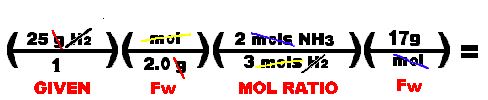
25g H2/1 Change to mols of hydrogen by the formula weight of hydrogen 1 mol of H2 = 2.0 g. (The 2.0 g goes in the denominator to cancel with the gram units in the material given.) Change mols of hydrogen to mols of ammonia by the mol ratio. 3 mols of hydrogen = 2 mols of ammonia. (The mols of hydrogen go in the denominator to cancel with the mols of hydrogen. You are now in units of mols of ammonia.) Convert the mols of ammonia to grams of ammonia by the formula weight of ammonia, 1 mol of ammonia = 17g. (Now the mols go in the denominator to cancel with the mols of ammonia.) Cancel the units as you go.
The math on the calculator should be the last thing you do. 2 5 ÷ 2 . 0 x 2 ÷ 3 x 1 7 = and the number you get (141.66667) will be a number of grams of ammonia as the units in your calculations show. Round it to the number of significant digits your instructor requires (often three sig. figs.) and put into scientific notation if required. Most professors suggest that scientific notation be used if the answer is over one thousand or less than a thousandth. The answer is 142 grams of ammonia.
The calculator technique in the preceding paragraph illustrates a straightforward way to do the math. If you include all the numbers in order as they appear, you will have less chance of making an error. Many times students have been observed gathering all the numbers in the numerator, gathering all the numbers in the denominator, presenting a new fraction of the collected numbers, and then doing the division to find an answer. While this method is not wrong, the extra handling of the numbers has seen to produce many more errors.
This example starts at “mass given” and goes through the mol ratio to “mass find.”

Notice by the chart above we may get the number of mols of material given if we change the mass by the formula weight, but in our continuous running math problem, we don’t have to stop and calculate a number of mols. Students who insist on doing problems piecemeal tend to get more calculator errors.
The more traditional formula for converting mols to mass would be, where Fw is the formula weight, m is the mass, and n is the number of mols: n x Fw = m. You should be able to “see” these formula relationships on the roadmap.
Density Times Mass of a Pure Material
Density multiplied by the volume of a pure material is equal to the mass of that material. If we know the density of a material and the volume of the pure material, with D = density and V = volume, DV = m so:

If you were given the density and volume of pure material you could calculate the volume of another material in that equation if you know its density. Notice that the density must be inverted to cancel the units properly if you want the volume to find. If you need to find the density, the volume must be inverted.
Atoms or Molecules to Moles
One of the hardest ideas for some students is that the individual particles of a material are a single one of a formula of that material. Copper element comes only in the form of atoms. Water only comes in the form of a molecule with one oxygen and two hydrogen atoms. A mol, then is Avogadro’s number of individual particles of whatever type of pure material the substance is made. There is no such thing as a mol of mud because mud is a mixture. There is no one mud molecule.
The word “pure” also can be misunderstood. We do not mean that a material is one hundred percent the same material for us to use it, but that we are only considering the amount of that material.
The formula behind this relationship is: where n is the number of mols, A is Avogadro’s number, and # is the number of individual particles of material:
A x n = #.
Concentration Times Volume of a Solution
A solution is a mixture of a fluid (often water, but not always) and another material mixed in with it. The material mixed in with it is called the solute. There is more on solutions in the chapter devoted to that. The volume of a solution, V, is measured the same way the volume of a pure liquid is measured. The concentration can be expressed in a number of ways, the most common in chemistry is the M, molar. One molar is one mol of solute in a liter of fluid. It is important to notice that the fluid is usually nothing more than a diluting agent. For most of the reactions, the fluid does not participate in any reaction.
Concentration times volume is number of mols of the solute material, or:
C x V = n
The “given” side of concentration times volume is easy. As with density times volume of a pure material, but the “find” side may need more work. You need one or the other of the concentration and volume before you can calculate the other. At the end of the Dimensional Analysis if you want concentration, you will be using the volume inverted. If you want the volume, you will be using the concentration inverted. This is not so difficult because the units will guide you.
Gases
Standard temperature is zero degrees Celsius. Standard pressure is one atmosphere. A mol of ANY gas at standard temperature and pressure (STP) occupies 22.4 liters. That number is good to three significant digits. The equation would be 1 mol gas = 22.4 L @STP. The conversion factor, the Molar Volume of Gas, is 1 mol gas/22.4 L @STP or 22.4 L @STP/1 mol gas.
Where n is the number of mols, V is the volume of a gas, and MVG is the molar volume of gas,
V = n x MVG
Gases not at STP will require the Ideal Gas Law Formula,
P V = n R T
where P is the pressure of the gas in atmospheres, V is the volume of the gas in liters, n is the number of mols of gas, T is the Kelvin temperature of the gas, and R is the “universal gas constant” with the measurement of 0.0821 liter-atmospheres per mol-degree. We will have to do some algebra on the PV = nRT gas equation to do the gas portion of the stoichiometry problems.
In GIVEN we only need to solve for n. n = PV/RT. If we need to find the volume, pressure, or temperature of a gas, we need to solve for the unknown and include the “mols find” as the n. More about gases later.
The earmarks of a stoichiometry problem are: There is a reaction. (A new material is made.) You know the amount of one material and you are asked to calculate the amount of another material in the same equation.
Stoichiometry Roadmap
How To Use The “Roadmap” For Solving Chemistry Problems
1. Write all the compounds and elements in the problem correctly.
2. Write the balanced chemical equation for the problem.
3. Write the MATERIAL you have enough information about to use as GIVEN. (This has been one of the major stumbling blocks in using the roadmap.) If you know the number of moles, the mass, or the number of molecules of a material, you have all you need to start the problem. You need CONCENTRATION AND VOLUME of a solution to have the amount of solute that reacts. You need VOLUME AND DENSITY of a solid or liquid to have an amount of that. You need VOLUME, PRESSURE AND TEMPERATURE of a gas to have a complete set of information. (Notice it is useful to understand the properties of the states of matter as you do this.)
4. Write what you need to FIND and all the other pertinent information about that material. For instance, if you need to find the volume of a gas, you must also list the pressure and temperature of that gas in FIND. In this manner: FIND V, volume of gas at 79°C and 1.8 atm.
5. Sketch out an outline of the math according to the roadmap. You know there are some points in the roadmap that you miss on the outline because they are calculated in the process, for instance if you are given a mass of one material and asked to find the density of another material with its volume, you would start at the MASS GIVEN and use the FORMULA WEIGHT to get to the MOLES GIVEN, but MOLES GIVEN does not appear in the outline because it is already calculated. You next need the MOLE RATIO to get the MOLES FIND. Again, MOLES FIND does not appear in the outline.
6. Fill in the outline with the numbers, units and materials (for instance, 15 kg Mg) and do the calculations. Be careful of numbers that need to be inverted. You can tell the coefficients that need to be inverted by the units.
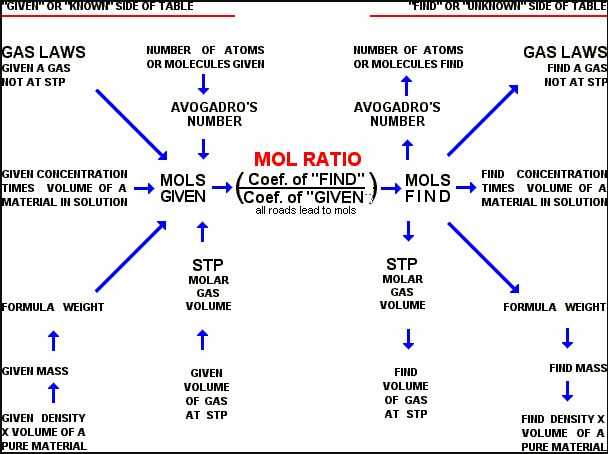
One of the really nice things about the Stoichiometry Roadmap is that once you understand it thoroughly, it can be carried around with you between your ears. Just remember that ALL ROADS LEAD TO MOLS.
Mole and Percent Worksheet
1. How many pennies are in a mole of pennies? How many
thousand-dollar bills (k-notes!) is that mole of pennies equal
to?
2. NO2 is the molecular formula for
nitrous dioxide (also known as nitrogen dioxide). List the
information available to you from this formula.
3. C2H2 is the
molecular formula for ethyne (A.K.A. acetylene).
(a) How many atoms are in one molecule
(b) Which atoms make up acetylene (c) How many moles of atoms are in one
molecule of acetylene (d) How many molecules are
in 5.3 moles of acetylene (e) How many atoms are
in a mole of acetylene
4. Calculate the molar mass of a mole of the following
materials: (a) Al (b) Ra (c) Co (d) CO (e) CO2 (f) HCl (g) Na2CO3 (h) Ca(NO3)2 (i) (NH4)3(PO4)
(j) H2O (k) Epsom salts –
Mg(SO4) · 7H2O (m)
blue vitriol – Cu(SO4) · 5H2O
5. Calculate the number of moles in: (a) 2.3 # of carbon (b)
0.014 g of Tin (c) a 5 Oz silver bracelet (d) a pound of table
salt (e) a 350 kg cast iron engine block (f) a gal. of water (8.3
#) (g) a ton of sand (SiO2) (h) 6.2 grams of
blue vitriol (i) a pound of Epsom salts
6. Calculate the number of atoms in: (a) 100 g of Argon (b)
1.21 kg aluminum foil (c) a 28 # lead brick (d) the E7 kg of water in
an Olympic swimming pool (e) 7 kg of hydrogen gas (f) a tonne of
calcium nitrate
7. What is the percentage composition of oxygen in each of the
following materials: (a) CO (b) CO2 (c)
(NO3)–
(d) isopropyl alcohol C3H8O
(e) calcium nitrate (f) blue vitriol – Cu(SO4) · 5H2O
8. What is the percentage composition of phosphate in each of
the following materials: (a) phosphoric acid (b) sodium
carbonate (c) ammonium phosphate (d) calcium phosphate
9. What is the percentage composition of sulfate in each of
the following materials: (a) sulfuric acid (b) sodium sulfate (c)
Epsom salts (d) aluminum sulfate
Answers to Mole and Percent Problems
| 1a. 6.023 E23 pennies | 1b. 6.023 E18 k-Notes | 2a. Covalent | ||
| 2b. Elements in it (N and O) |
2c. Number of atoms of each element |
|||
| 3a. 4 | 3b. C & H |
3c. 6.64 E-24 | 3d. 3.1922 E24 |
3e. 2.4092 E24 |
| 4a. 27.0 | 4b. 226.0 |
4c. 58.9 | 4d. 28.0 |
4e. 44.0 |
| 4f. 36.5 | 4g. 106.0 |
4h. 164.1 | 4i. 149.0 |
4j. 18.0 |
| 4k. 246.4 | 4m. 249.6 |
5a. 86.9 | 5b. 1.18 E-4 |
5c. 1.31 |
| 5d. 7.75 | 5e. 6.27 E3 | 5f. 210 | 5g. 1.51 E4 | 5h. 0.0248 |
| 5i. 1.84 | 6a. 1.51 E24 | 6b. 2.69 E25 |
6c. 3.69 E25 | 6d. 1.00 E33 |
| 6e. 4.22E27 | 6f. 3.30 E28 | 7a. 57.1% |
7b. 72.7% | 7c. 77.4% |
| 7d. 26.7% | 7e. 58.5% | 7f. 57.7% | 8a. 96.9% | 8b. 0% |
| 8c. 63.8% | 8d. 61.2% | 9a. 98.0% | 9b. 67.6% | 9c. 39.0% |
| 9d. 84.2% | ||||
STP Gas and Mass Stoichiometry Problems (Preliminary to Gas Law)
All of the problems below are stoichiometry problems with at
least one equation participant as a gas at STP. (a) Write and
balance the chemical equation. (2) Do the math in DA style using
1 mole gas at STP = 22.4 liters as a factor. In the following
problems ALL GASES ARE AT STP.
1. How many moles of nitrogen gas is needed to react with 44.8
liters of hydrogen gas to produce ammonia gas?
2. How many liters of ammonia are produced when 89.6 liters of
hydrogen are used in the above reaction?
3. Ten grams of calcium carbonate was produced when carbon
dioxide was added to lime water (calcium hydroxide in solution).
What volume of carbon dioxide at STP was needed?
4. When 11.2 liters of hydrogen gas is made by adding zinc to
sulfuric acid, what mass of zinc is needed?
5. What volume of ammonia at STP is needed to add to water to
produce 11 moles of ammonia water?
6. How many grams of carbonic acid is produced when 55 liters
of carbon dioxide is pressed into water?
7. magnesium hydroxide + ammonium sulfate -> magnesium sulfate + water +
ammonia
How much (grams) magnesium hydroxide do you need to use in the
above reaction to produce 500 liters of ammonia?
8. How much strontium bromide is needed to add to chlorine gas
to produce 75 liters of bromine?
9. What mass of ammonium chlorate is needed to decompose to
give off 200 liters of oxygen?
10. Your car burns mostly octane, C8H18, as a fuel. How many
liters of oxygen is needed to burn a kilogram of octane?
11. copper + sulfuric acid -> copper II sulfate
+ water + sulfur dioxide
How many moles of copper are needed to produce 1000 L of
SO2?
12. What volume of oxygen is needed to burn a pound of
magnesium?
13. How many grams of sodium do you have to put into water to
make 30 liters of hydrogen at STP?
14. Ammonia gas and hydrogen chloride gas combine to make
ammonium chloride. What volume of ammonia at STP is needed to
react with 47.7 liters of hydrogen chloride at STP?
15. How many liters of oxygen are needed to burn 10 liters of
acetylene?
Answers to STP Gas and Mass Stoichiometry Problems
| 1. 0.667 mol | 2. 59.7 L |
3. 2.24 L | 4. 32.7 g |
| 5. 246 L | 6. 152 g | 7. 651 g | 8. 828 g |
| 9. 604 g | 10. 2.46 kL | 11. 44.6 mol | 12. 210 L |
| 13. 61.6 g | 14. 47.7 L | 15. 25 L |
Concentration and Density Problems
WRITE AND BALANCE THE CHEMICAL EQUATION FOR THOSE PROBLEMS
THAT NEED IT. SHOW ALL YOUR WORK. USE W5P OR DA METHOD ACCORDING
TO THE ROADMAP.
1. The lead brick on my desk measures 3 by 5 by 11 cm. Lead
has a density of 11.34 g/cc. How many lead atoms are in that
block?
2. The lab technician at the peanut packing factory
takes a bag of peanuts, puts water into it to dissolve the salt,
and dilutes the solution to one liter. She then takes ten ml of
that solution and titrates it against 0.132 M silver nitrate. One
bag sample takes 31.5 ml of silver nitrate to endpoint. What mass
of salt was in the bag?
3. What is the concentration of sugar (C12H22O11)
if twenty grams are dissolved in enough water to make 2
liters?
4. Methyl alcohol (CH3OH) has a density of
0.793 kg/l. What volume of it is needed to add to water to make
five liters of 0.25 M solution?
5. Magnesium has a density of 1.741 g/cc. What volume of Mg
will burn in 20 liters of oxygen at 2.1 atm and 0°C?
6. Uranium metal can be purified from uranium hexafluoride by
adding calcium metal. Calcium metal has a density of 1.54 g/cc.
Uranium has a density of 18.7 g/cc. What mass of uranium do you
get for a Kg of Ca? What volume of uranium do you get for a cubic
meter of calcium?
7. What volume of 0.27 M sodium hydroxide is needed to react
with 29.5 ml of 0.55 M phosphoric acid?
8. What volume of carbon dioxide is produced at 1 atm and
87 °C when 1.6 liters of methyl alcohol burns? What volume of
liquid water is produced in this reaction?
9. Seven kilograms of mercury II oxide decomposes into mercury
and oxygen. Mercury has a density of 13.6 g/cc/ What volume of
mercury is produced?
10. Water and calcium oxide produce calcium hydroxide. How
many grams of calcium hydroxide are made if you add 275 liters of
water to enough calcium oxide?
11. Gasoline (C7H16)
has a density of 0.685 kg/liter. How many liters of oxygen at
37 °C and 950 mmHg are needed to burn 15 liters of gasoline?
12. Sodium hydroxide and hydrochloric acid combine to make
table salt and water. 14 mL of 0.1 M sodium hydroxide is
added to an excess of acid. How many moles of table salt are
made? How many grams of salt is that?
13. 50 mL of 0.25 M copper II sulfate evaporates to leave
CuSO4 · H2O. (That is the pentahydrate crystal of copper II
sulfate.) What is the mass of this beautiful blue crystal from
the solution?
14. Chlorine gas is bubbled into 100 mL of 0.25 M potassium
bromide solution. This produces potassium chloride and
bromine gas. The bromine (which dissolves in water) is taken from
the solution and measured at 27 °C and 825 mmHg.
What is the volume of bromine?
15. 95.0 mL of 0.55 M sulfuric acid is put on an excess of
zinc. This produces zinc sulfate and hydrogen. How many grams of
zinc sulfate are made?
16. 27.6 mL of a 0.190 M solution of silver nitrate and 15.4
mL
of an unknown (but excess) amount of sodium chloride
combine to make a white precipitate silver chloride and some
dissolved sodium nitrate. (a) How many moles of silver
chloride are made? (b) How many grams of silver chloride is that?
(c) How many moles of sodium nitrate are made? (d)
What is the concentration of sodium nitrate in the final
solution?
17. How many grams of potassium permanganate, KMnO4, is
needed to make 1.72 liters of 0.29 M solution?
18. By my calculations, a drop of ethyl alcohol, C2H5OH , in
an Olympic-sized swimming pool produces a 1.20 E-10 M
solution of alcohol in water. A drop is a twentieth of a mL. How
many molecules of ethyl alcohol are in a drop of the water
in the pool?
19. 93.0 mL of 0.150 M magnesium hydroxide is added to 57.0 mL
of 0.4 M nitric acid. (Magnesium nitrate and water are
formed. What is the concentration of the magnesium nitrate after
the reaction?
Answers to Concentration and Density Problems
| 1. 5.44 E24 atoms | 2. 24.3 g | 3. 0.0292 M | 4. 0.0504 L |
| 5. 52.3 ml(cc) Mg | 6a. 1.98 kg of U |
6b. 1.63 E6 mL | 7. 180 mL |
| 8a. 1.17 kL CO2 * | 8b. 1.43 L | 9. 0.477 L | 10. 1.13 E 6 g |
| 11. 23.0 kL * | 12a. 1.4 E-3 mols | 12b. 0.0819 g | 13. 3.12 g |
| 14. 284 mL | 15. 8.44 g | 16a. 5.24E-3 mol | 16b. 0.752 g |
| 16c. 5.24E-3 mols | 16d. 122 mmolar |
17. 78.8 mg | 18. 3.61E9 molecules |
| 19. 0.152 M |
* The unit “kL” or “kiloliter” is not a recognized SI unit. It does calculate to the same volume as a cubic meter, m3.
Complete Roadmap Problems
1. How many liters of ammonia at 0°C and 25
atm. are produced when 10 g of hydrogen is combined with
nitrogen?
2. How many milliliters of hydrogen at 0°C and 1400 mmHg
are made if magnesium reacts with 15 mL of 6 M sulfuric
acid?
3. How many atoms are in 25 liters of fluorine gas at 2.85 atm
and 450°C?
4. Liquid butane (C4H10)
has a density of 0.60 g/cc. It burns to
make carbon dioxide at 120°C. What volume of carbon
dioxide is produced at one atm when 350 liters of liquid butane
burns?
5. Isopropyl alcohol, C3H7OH, makes a good fuel for cars. What
volume of oxygen at 785 mmHg and 23°C is needed to
burn 8.54 E25 molecules of isopropyl alcohol?
6. How many moles of NaCl are in a liter of a 0.15 M NaCl
solution? (0.15 M NaCl is physiological saline when
sterilized.)
7. How many grams of NaCl must you put into a 50 liter
container to make a physiological saline solution?
8. Chlorine gas is bubbled into 100 mL of 0.25 M potassium
bromide solution. This produces potassium chloride and
bromine gas. The bromine dissolves completely in the water. What
is the concentration of bromine?
9. 95 mL of 0.55 M sulfuric acid is put on an excess of zinc.
This produces zinc sulfate and hydrogen. How many grams of
zinc sulfate are made?
10. Methyl alcohol (CH3OH) has a density
of 0.793 Kg/L. What volume of it is needed to add to water to
make twenty-five liters of 0.15 M solution?
11. Magnesium has a density of 1.741 g/cc. What volume of Mg
will burn to produce a kilogram of magnesium oxide?
12. What volume of water vapor is produced at 716 mmHg and
87°C
when 2.6 liters of methyl alcohol burns?
Answers to Complete Roadmap Problems
| 1. 2.99 L | 2. 1.10 E3 mL |
3. 1.45 E24 atoms | 4. 4.67 E5 L |
| 5. 1.50 E4 L | 6. 0.15 moles | 7. 439 g | 8. 0.125 M |
| 9. 8.44 g | 10. 151 mL | 11. 0.346 L | 12. 1.29 E5 L |